
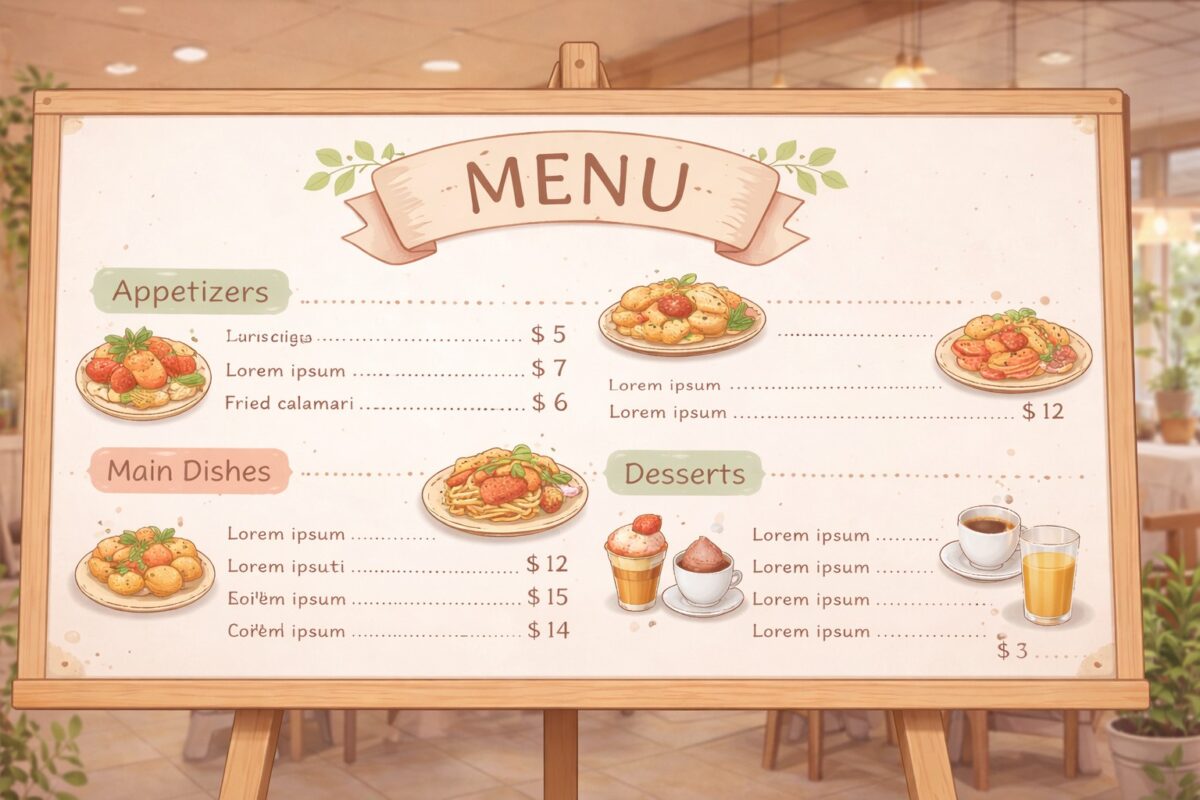
You sit down at a restaurant, open the menu, and within minutes you’ve made a decision that feels entirely your own. But is it? Behind that laminated card — or that sleek leather-bound booklet — lies a carefully engineered psychological landscape. Restaurateurs, menu consultants, and behavioral economists have spent decades studying how the human brain reads, evaluates, and chooses from a list of options. The result is a discipline sometimes called menu engineering, and at its heart are two powerful forces: anchoring and a constellation of cognitive biases that quietly steer your hand toward the dishes that make the restaurant the most money.
The Anchor and the Illusion of Value
Anchoring is one of the most robust findings in behavioral economics, first documented by Daniel Kahneman and Amos Tversky in the 1970s. The principle is simple: the first number you encounter in a comparison sets a psychological “anchor” against which all subsequent numbers are judged — often irrationally.
In a restaurant context, this means that a $75 Wagyu steak at the top of a steakhouse menu is not necessarily there because the chef expects you to order it. It is there to make the $42 ribeye feel like a bargain. The $75 item is a decoy, an anchor that recalibrates your internal sense of what is “reasonable” to spend. After seeing the high anchor, spending $42 feels restrained and sensible, even if you walked in expecting to spend $28.
The French Laundry in Napa Valley has long used this principle masterfully. Their prix-fixe tasting menus — routinely priced above $350 per person before wine — serve as a high anchor for the entire dining experience. A guest considering the wine list, which might otherwise seem expensive in isolation, feels relatively at ease spending $120 on a bottle, because the frame of reference has already been established at a much higher level.
In a more everyday setting, chains like The Cheesecake Factory in the United States famously feature menus that run to over 200 items, with prices spanning an enormous range. Researchers from Cornell’s Center for Hospitality Research have noted that this breadth creates multiple anchors at once, making the mid-tier options — which carry the best margins — feel like the sweet spot.
Placement and the “Golden Triangle”
Before a diner even reads prices, their eyes have already done the work of deciding what matters. Eye-tracking studies conducted at Cornell University and by menu consultancy firms in Europe reveal a consistent pattern: when presented with a single-page menu, the eye first travels to the upper right corner, then the top center, then back to the left. This path has been dubbed the Golden Triangle.
Items placed in the Golden Triangle receive disproportionately high attention and are ordered more frequently. Restaurants that understand this place their highest-margin dishes — not necessarily their most expensive ones — in these zones. At Nobu, the upscale Japanese-Peruvian chain with locations from London to Dubai, the menu is structured so that signature dishes like black cod with miso appear in visually prominent positions, reinforcing both the brand identity and the kitchen’s profitability.
For multi-page or booklet-format menus, the same logic applies to the inside right page of the opening spread, which receives the highest dwell time.
The Decoy Effect: Making the Middle Feel Right
The decoy effect — also called the asymmetric dominance effect — is one of the most elegant cognitive biases at work in menu design. It works like this: when given two options, people often find them genuinely difficult to compare. But introduce a third option that is clearly inferior to one of the first two (but not the other), and suddenly the “superior” option feels like an obvious choice.
Consider a simple drinks menu:
- House wine: ₹600
- Mid-range wine: ₹950
- Premium wine: ₹1,800
The mid-range wine at ₹950 is hard to evaluate on its own. But if it is described as coming from a prestigious region, aged for a specific number of years, and paired with a tasting note — while the house wine has no description at all — the mid-range becomes the “reasonable” choice. The ₹1,800 bottle serves as the high anchor, the ₹600 bottle serves as the decoy making the house option feel unambitious, and the ₹950 bottle sells itself.
Dishoom, the beloved Bombay-inspired restaurant group in the UK, uses this framework with their drinks and small plates menus. Their menu descriptions are so vivid and atmospheric for certain items that the moderately priced options feel richly justified, while cheaper alternatives seem sparse by comparison.
Charm Pricing and the Magic of .99 — And Why Fine Dining Abandons It
Walk into a McDonald’s anywhere in the world and you will see prices ending in .99 or .49. Walk into a Michelin-starred restaurant and you will see round numbers: 48, 95, 120. This is not accidental.
Charm pricing — the practice of ending prices in .99 — exploits the left-digit anchoring effect. Because we read left to right, the brain registers ₹499 as “four hundred and something” before it finishes processing the full number, making it feel meaningfully cheaper than ₹500. Fast food chains and mid-market restaurants worldwide use this technique to drive volume on lower-ticket items.
But upscale restaurants deliberately do the opposite. Round numbers project confidence, quality, and the sense that the establishment is above the indignity of nickel-and-diming. Research published in the Journal of Consumer Psychology found that rounded prices increase the perception of luxury and craftsmanship, because they suggest the price was set based on value, not optimization. El Celler de Can Roca in Girona, Spain — regularly ranked among the world’s best restaurants — uses round pricing throughout, reinforcing the idea that you are paying for an experience, not a transaction.
Removing Currency Symbols: Spending Without Pain
One of the subtlest tricks in upscale menu design is the removal of the currency symbol entirely. Instead of “$42,” the menu reads simply “42.” This is not an oversight. Research from Cornell’s Center for Hospitality Research, led by Professor Sheryl Kimes, demonstrated that diners who were shown menus without dollar signs spent significantly more than those who saw prices with the symbol. The dollar sign — or any currency symbol — is what researchers call a “pain of paying” trigger. It reminds the diner that money is changing hands.
Luxury hotels and restaurants in Tokyo, Paris, and New York have adopted this technique widely. Le Bernardin in New York City, one of the most decorated French seafood restaurants in the world, presents many of its tasting menu options simply as numerals, divorced from the transactional reality of what is being spent.
Descriptive Language and the Halo Effect
Menu descriptions are not merely informative — they are persuasive architecture. A study by Professor Brian Wansink at Cornell found that menu items with descriptive labels (“Grandma’s zucchini cookies,” “succulent Italian seafood filet”) were rated as tasting better and were ordered 27% more often than the same items with plain names.
The halo effect is at play here: a vivid, evocative description creates a positive impression that spills over into how the actual dish is perceived. Geographic cues are particularly powerful. “French Dijon mustard” sounds more authoritative than “mustard.” “Hand-rolled pasta from Emilia-Romagna” commands a higher perceived value than “fresh pasta.”
Ottolenghi restaurants in London are a masterclass in this technique. Their menu descriptions are almost literary — listing origins, techniques, and sensory cues in a way that makes each dish feel like a considered act of culinary geography. Diners don’t just order; they feel they are making an informed and sophisticated choice.
In contrast, Din Tai Fung, the Taiwanese dumpling chain with outposts across Asia, Australia, and the United States, takes the opposite approach. Their menus are deliberately spare and photographic, relying on visual anchoring rather than language. A full-color image of a perfectly pleated xiao long bao creates an aspirational visual anchor that words could barely match.
Scarcity and Social Proof: The Power of “Chef’s Selection”
Scarcity bias — the tendency to assign more value to things that seem rare or limited — is activated in menus through phrases like “available today only,” “limited seasonal preparation,” or “chef’s recommendation.” These signals tell the brain that the opportunity cost of not ordering is high.
At Noma in Copenhagen, the concept of hyper-seasonal, foraged menus was not just a culinary philosophy but a masterful scarcity signal. The impossibility of having the same dish twice created extraordinary demand and legendary waiting lists, demonstrating that perceived scarcity can be a restaurant’s most powerful marketing tool.
Social proof operates similarly. A label reading “Most Popular” or “Guest Favourite” beside a dish exploits our tendency to trust the collective judgment of others, particularly when we feel uncertain. TGI Fridays and Applebee’s in the United States use this technique extensively on their tabletop displays, and the technique has migrated to digital menus through platforms like Zomato and Swiggy in India, which show “Bestseller” badges on high-converting items — a mechanism that generates feedback loops of popularity.
The Box and the Border: Visual Isolation
On any restaurant menu, a dish placed inside a box or highlighted with a border draws the eye like a spotlight. This technique exploits the Von Restorff effect (also called the isolation effect), a well-documented cognitive bias that holds that people are more likely to remember — and select — items that stand out from their surroundings.
Menu designers at firms like Gregg Rapp Menu Engineering in the United States counsel their restaurant clients to box no more than one or two items per section, because overuse dilutes the effect entirely. The boxed item is invariably a high-margin dish that the restaurant wants to move.
Hard Rock Cafe, which operates across dozens of countries from Mumbai to Milan, uses graphic design elements to create visual hierarchy on their menus, guiding international guests toward signature burgers and shareable platters that drive the highest per-table revenue.
The Length of the Menu: Paradox of Choice
Barry Schwartz’s paradox of choice — the finding that more options can produce less satisfaction and more decision paralysis — has had a measurable impact on modern menu design. In the aftermath of the COVID-19 pandemic, restaurants around the world dramatically trimmed their menus, and many discovered to their surprise that sales held steady or increased, food waste dropped, and kitchen efficiency improved.
Gordon Ramsay famously advocated for shorter menus throughout his career and television work, arguing that a focused menu signals mastery rather than compromise. Sketch in London, the avant-garde restaurant and art space, structures its menus as curated experiences in each of its rooms rather than exhaustive lists, turning the constraint itself into a form of theatre.
In Japan, the tradition of ichiju sansai — one soup and three sides — reflects a cultural philosophy of restraint that happens to sidestep the paradox of choice entirely. Restaurants in Kyoto serving kaiseki cuisine operate on similar principles: the chef decides, and the decision is trusted implicitly.
Digital Menus and the New Frontier of Bias
The migration to QR-code menus and digital ordering — accelerated by the pandemic — has opened new frontiers for behavioral design. Platforms can now A/B test menu layouts in real time, serve different menus to different demographic groups, and use machine learning to identify which visual arrangements drive the highest average order values.
McDonald’s uses dynamic digital menu boards in many of its markets that change based on time of day, weather, and even traffic patterns, showing breakfast items in the morning and automatically surfacing high-margin upsell combinations at peak dinner times. This is anchoring at algorithmic scale.
In India, platforms like Swiggy Instamart and restaurant-facing tools from Zomato allow operators to configure “sponsored” or “promoted” placements for items within the digital menu, essentially monetizing the Golden Triangle principle in a new medium.
The Menu as a Mirror
Every menu is a map of a restaurant’s ambitions, margins, and understanding of human psychology. The finest examples — from the handwritten blackboard specials of a Paris bistro to the leather-bound folio of a Tokyo tasting counter — are works of design that balance beauty, clarity, and careful behavioral engineering.
For diners, awareness of these techniques does not diminish the pleasure of eating out. If anything, it enriches the experience: to know that the perfectly placed item, the evocative description, and the well-judged anchor are all working in concert is to appreciate that a great meal begins before the first bite is taken. It begins the moment your eyes fall on the page.
References draw on research from Cornell University’s Center for Hospitality Research, the work of Daniel Kahneman and Amos Tversky on anchoring, Brian Wansink’s studies on menu language (Cornell), Barry Schwartz’s “The Paradox of Choice,” and menu engineering principles developed by Gregg Rapp and other industry consultants.